# "Instanced Objects" in Blueprints

{% hint style="success" %}
verified: 2025-11-19 version: v39
{% endhint %}

If a UObject property is marked as "instanced", then it will allow you to create the subobjects within the defaults of a class, which is useful for making data driven systems and config assets.

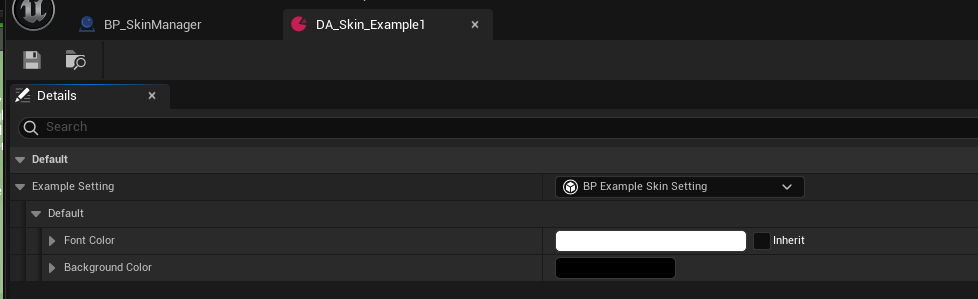
<figure><img src="/files/M3VTjYW1Ye52QxCNMK8R" alt=""><figcaption><p>The <code>Example Setting</code> is an instanced variable, allowing us to provide a <code>BP Example Skin Setting</code>, and assign its properties' values in-line inside the data asset.</p></figcaption></figure>

This is a feature that is not exposed to BP in native Unreal, but we have added some helpers to support this.

First is the `M2_InstancedObject` class. This is a simple UObject, but defaults to instanced, with inlined properties. This means that if you make a class that is a child of this, you can mark it as "instanced"

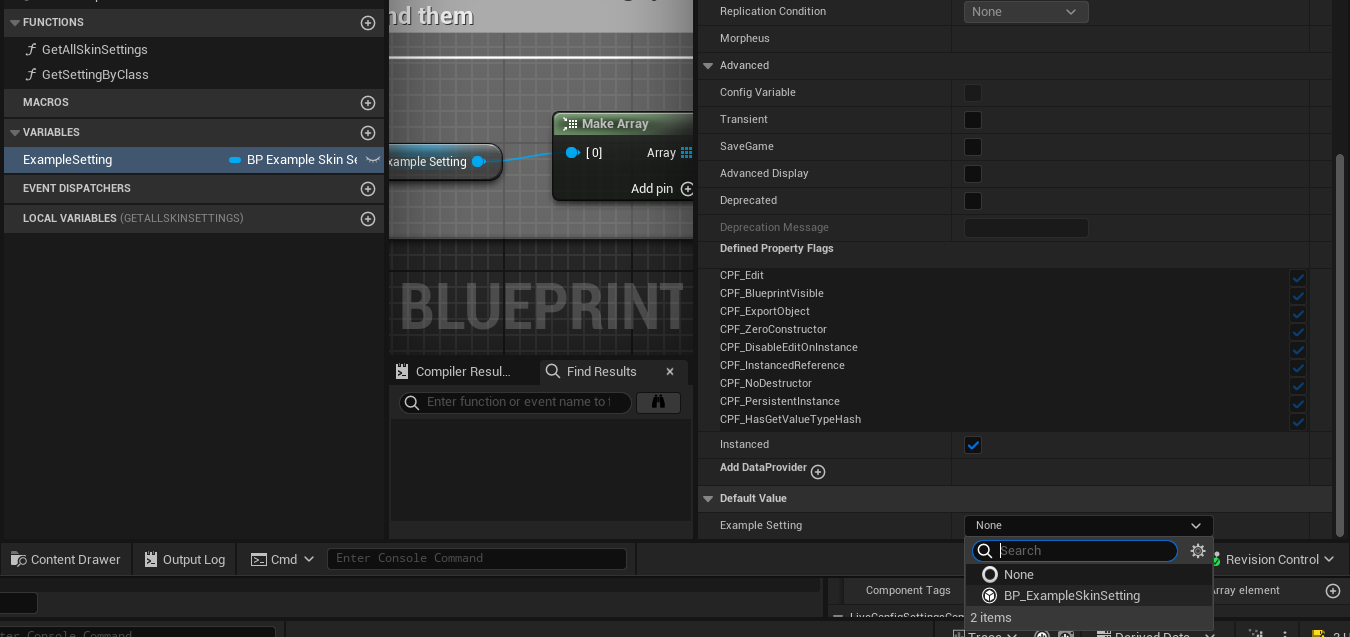
To mark a `M2_InstancedObject` subclass property, go to the `Details` panel, and expand the `Advanced` section. Check the `Instanced` checkbox, and recompile. You will then be able provide an instanced object in the default value.

<figure><img src="/files/eeOHt8wxp4Bf3EojZUuK" alt=""><figcaption></figcaption></figure>

{% hint style="warning" %}
NOTE: If the `Instanced` property is not visible, it could be that the variable class is not an `M2_InstancedObject` - not all classes can be marked as instanced.
{% endhint %}


---

# Agent Instructions: Querying This Documentation

If you need additional information that is not directly available in this page, you can query the documentation dynamically by asking a question.

Perform an HTTP GET request on the current page URL with the `ask` query parameter:

```
GET https://docs.msquared.io/creation/unreal-development/features-and-tutorials/helpers-and-extras/instanced-objects-in-blueprints.md?ask=<question>
```

The question should be specific, self-contained, and written in natural language.
The response will contain a direct answer to the question and relevant excerpts and sources from the documentation.

Use this mechanism when the answer is not explicitly present in the current page, you need clarification or additional context, or you want to retrieve related documentation sections.